JRODOS - Entscheidungshilfesysteme

Entscheidungshilfesysteme für das Notfallmanagement nach nuklearen oder radiologischen Unfällen oder Zwischenfällen kommen insbesondere im Falle einer Freisetzung radioaktiver Stoffe zum Einsatz. Ihr Hauptzweck besteht darin, alle Informationen bereitzustellen, die erforderlich sind, um schnell, kontinuierlich, konsistent und umfassend Entscheidungen über Maßnahmen zum Schutz der Bevölkerung zu treffen. Nutzer dieser Entscheidungshilfesysteme sind die für das Notfallmanagement zuständigen regionalen, nationalen und internationalen Institutionen und Organisationen. In Deutschland gehören dazu die zuständigen Einsatzzentralen des Bundes und der Länder.

Seit etwa 1990 entwickeln wir das System „Real-time On-line DecisiOn Support“ (JRODOS) für den operativen Einsatz in Notfallzentren in Deutschland, Europa und weltweit. Wichtige Forschungs- und Entwicklungsarbeiten an RODOS wurden im Rahmen des 4. Rahmenprogramms der Europäischen Kommission (1996–99) von rund 40 Institutionen aus fast 20 Ländern durchgeführt, darunter die EU, die Republik Belarus, Russland, die Ukraine sowie Polen, Ungarn, die Tschechische Republik, die Slowakei und Rumänien. Die ehemalige Arbeitsgruppe „Accident Management Systems“ am Forschungszentrum Karlsruhe – heute die Abteilung „Resilient and Smart Infrastructure Systems (RESIS)“ des Instituts für Thermische Energietechnik und Sicherheit (ITES) am KIT – war und ist weiterhin hauptverantwortlich für die Forschungs- und Entwicklungsarbeiten sowie deren Koordination.

Die erste einsatzfähige Version des RODOS-Systems für den Echtzeit- und Online-Einsatz in Leitstellen wurde Ende 2000 fertiggestellt. Gemeinsam mit unseren europäischen Projektpartnern wurde das RODOS-System bis 2009 inhaltlich und funktional kontinuierlich verbessert und erweitert, unter anderem im Rahmen von Forschungs- und Entwicklungsprojekten des Sechsten Rahmenprogramms der Europäischen Kommission (2002–2006). Die Arbeit orientierte sich in erster Linie an den Erfahrungen und Bedürfnissen der aktuellen und zukünftigen RODOS-Nutzenden. Im Rahmen dieser Arbeit wurde die Java-basierte Version von RODOS (JRODOS) entwickelt, die seit 2010 als Einsatzversion von RODOS dient.

Auf Initiative des ehemaligen Bundesministeriums für Umwelt (BMU; heute Bundesministerium für Umwelt, Klimaschutz, Naturschutz und Reaktorsicherheit, BMUKN) haben wir die Hardware- und Softwarekomponenten des RODOS-Systems beim Bundesamt für Strahlenschutz (BfS) in Neuherberg bei München konfiguriert und installiert. Nach der Einrichtungs- und Testphase im Jahr 2001 wurde RODOS in Betrieb genommen und auch von den Bundesländern genutzt. Mit der Einrichtung des Radiologischen Lagezentrums (RLZ) im Jahr 2017 wird JRODOS vom BfS als integraler Bestandteil dieses Zentrums betrieben.

Im Laufe von Jahrzehnten finanzierte die Europäische Kommission den Aufbau des JRODOS-Systems in den nationalen Notfallzentren europäischer und außereuropäischer Länder mit Mitteln aus europäischen Programmen wie TACIS, PHARE, ECHO, DEVCO und nun INTPA (International Partnerships). Derzeit ist JRODOS in mehr als 50 Ländern weltweit im Einsatz, und Installationen in weiteren Ländern sind im Gange.

Seit 2022 unterstützt das KIT weiterhin ukrainische JRODOS-Anwender, darunter die ukrainische Atomaufsichtsbehörde, die Notfallzentrale des Hydrometcenters sowie mehrere Anwender in Kernkraftwerken (KKW). Diese Unterstützung umfasst die Hilfe bei der Neuinstallation und Aktualisierung sowie die Durchführung täglicher Berechnungen für schwerwiegende „Was-wäre-wenn“-Szenarien in allen vier KKW der Ukraine unter Verwendung aktueller Wettervorhersagen. Die Fähigkeit von JRODOS, mehrere Szenarien einschließlich verschiedener Wetterbedingungen zu modellieren, bietet ein Mittel zum besseren Verständnis und zur Bewältigung von Unsicherheiten im Zusammenhang mit schweren Unfällen. Diese fortlaufende Unterstützung verbessert die Notfallvorsorge und die Reaktionsfähigkeit der jeweiligen Institutionen erheblich.
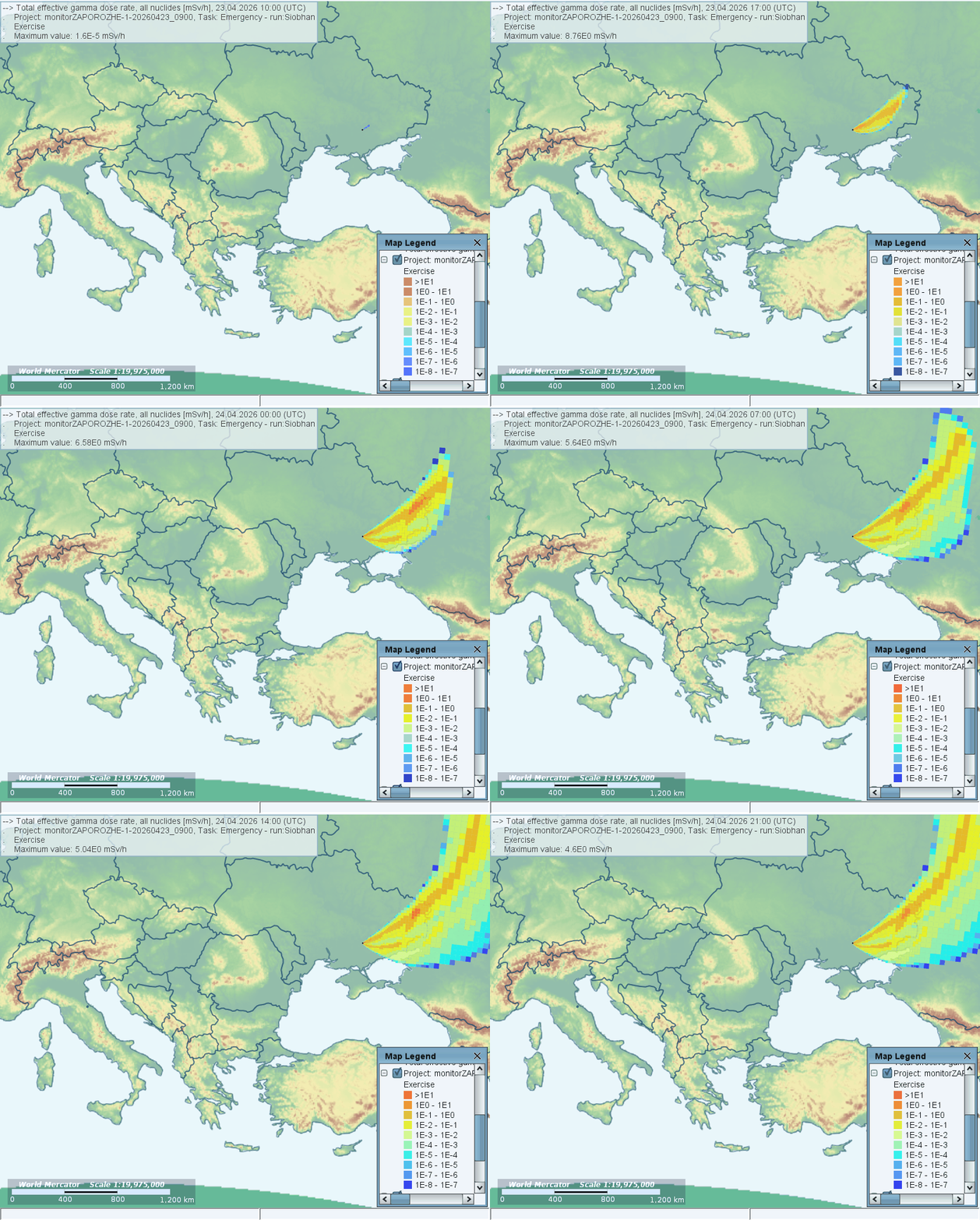
 
Simulation möglicher Unfallszenarien

Im Rahmen europäischer Forschungsprojekte wurden zahlreiche Nutzer des Systems zusammengebracht, deren Interessen bei der Weiterentwicklung des Systems durch die KIT-Forschungseinheit JRODOS berücksichtigt wurden. Dieses Netzwerk aus RODOS-Nutzern und -Entwicklern wird innerhalb der RODOS-Nutzergruppe fortgeführt. Die Gruppe trifft sich einmal jährlich, um Erfahrungen mit dem System auszutauschen und mögliche Weiterentwicklungen von JRODOS zu erörtern. Der nächste Workshop findet vom 21. bis 22. September 2026 in der CIPRIERN-Einsatzzentrale in Bukarest statt.

Ausführlichere Informationen zum Stand des JRODOS-Systems mit seinen weltweiten Installationen finden Sie hier: 

Kontakt:
Dr. rer. nat. Sadeeb Simon Ottenburger
KIT - Karlsruher Institut für Technologie
Institut für Thermische Energietechnik
und Sicherheit (ITES)
Hermann-von-Helmholtz-Platz 1
D- 76344 Eggenstein-Leopoldshafen
Tel: +49 721 608 25507
Fax: +49 721 608 28452
Email: ottenburger∂kit.edu

Netzwerk/Plattformen:

Projekte:


Publikationen


Facilitating the Decision‐Making Process After a Nuclear Accident : Case Studies in the Netherlands and Slovakia
Asselt, E. D. van; Twenhöfel, C. J. W.; Duranova, T.; Smetsers, R. C. G. M.; Bohunova, J.; Müller, T.
2021. Integrated environmental assessment and management, 17 (2), 376–387. doi:10.1002/ieam.4375
Semantic Variation Graphs: Ontologies for Pangenome Graphs
Bolleman, J. T.; Yokoyama, T. T.; Heumos, S.; Seaman, J.; Trybushnyi, D.; Pook, T.; Guarracino, A.; Garrison, E.
2020, Juli 16. International Conference on Intelligent Systems for Molecular Biology (2020), Online, 13.–16. Juli 2020
Semantic Variation Graphs: Ontologies for Pangenome Graphs
Yokoyama, T. T.; Heumos, S.; Seaman, J.; Trybushnyi, D.; Pook, T.; Guarracino, A.; Garrison, E.; Bolleman, J. T.
2020, Juli 15. International Conference on Intelligent Systems for Molecular Biology (2020), Online, 13.–16. Juli 2020
Case-Based Decision Support for Disaster Management. Dissertation
Möhrle, S.
2020, Juni 16. KIT Scientific Publishing. doi:10.5445/KSP/1000099369
MCDA stakeholder workshops
Duranova, T.; Asselt, E. van; Müller, T.; Bohunova, J.; Twenhöfel, C. J. W.; Smetsers, R. C. G. M.
2020. Radioprotection, 55 (HS1), S193–S196. doi:10.1051/radiopro/2020032
Agent based model
Bai, S.; Raskob, W.; Müller, T.
2020. Radioprotection, 55 (HS1), S187–S191. doi:10.1051/radiopro/2020031
MCDA handling uncertainties
Müller, T.; Bai, S.; Raskob, W.
2020. Radioprotection, 55 (HS1), S181–S185. doi:10.1051/radiopro/2020030
A new European cancer risk assessment tool for application after nuclear accidents
Walsh, L.; Ulanowski, A.; Kaiser, J. C.; Woda, C.; Raskob, W.
2020. Radioprotection, 55 (HS1), S95–S99. doi:10.1051/radiopro/2020018
Education and training activities in the Euratom CONFIDENCE project
Duranova, T.; Beresford, N. A.; Perko, T.; Raskob, W.
2020. Radioprotection, 55 (HS1), S45–S50. doi:10.1051/radiopro/2020011
Confidence: achievements and way forward
Raskob, W.; Beresford, N. A.; Duranova, T.; Korsakissok, I.; Mathieu, A.; Montero, M.; Müller, T.; Turcanu, C.; Woda, C.
2020. Radioprotection, 55 (HS1), S39–S43. doi:10.1051/radiopro/2020010
Uncertainty visualization using maps for nuclear and radiological emergencies
Nagy, A.; Perko, T.; Müller, T.; Raskob, W.; Benighaus, L.
2020. Radioprotection, 55 (HS1), S197–S203. doi:10.1051/radiopro/2020033
CONFIDENCE: project description and main results
Raskob, W.; Beresford, N. A.; Duranova, T.; Korsakissok, I.; Mathieu, A.; Montero, M.; Müller, T.; Turcanu, C.; Woda, C.
2020. Radioprotection, 55 (HS1), S7–S15. doi:10.1051/radiopro/2020008
Editorial: the main results of the European CONFIDENCE project
Raskob, W.; Duranova, T.
2020. Radioprotection, 55 (HS1), S1–S5. doi:10.1051/radiopro/2020007
Energy consumption models in dialysis clinics for agent-based decision support
Wandler, S.; Bai, S.; Raskob, W.
2020. International journal of simulation and process modeling [modelling], 15 (1-2), 170–188. doi:10.1504/IJSPM.2020.106981
Source term reconstruction module in JRODOS
Raskob, W.; Haller, C.; Hasemann, I.; Schichtel, T.; Trybushnyi, D.
2020. 5th NERIS Workshop "Key challenges in the preparedness, response and recovery phase of a nuclear or radiological emergency". Proceedings, 112–118
Agent-based Negotiation Simulation
Bai, S.; Raskob, W.
2020. 5th NERIS Workshop "Key challenges in the preparedness, response and recovery phase of a nuclear or radiological emergency". Proceedings, 53–62
CONFIDENCE dissemination meeting: Summary on the scenario-based workshop
Duranova, T.; Bedwell, P.; Beresford, N. A.; Bleher, M.; Gering, F.; Geertsema, G.; Hamburger, T.; Kaiser, J. C.; Korsakissok, I.; Leadbetter, S. J.; Montero, M.; Müller, T.; Oughton, D.; Perko, T.; Raskob, W.; Tomas, J.; Turcanu, C.; Vries, H. de; Walsh, L.; Woda, C.
2020. Radioprotection, 55 (HS1), S17–S37. doi:10.1051/radiopro/2020009
MCDA-based Genetic Algorithms for Developing Disaster Resilient Designs of Critical Supply Networks
Ottenburger, S. S.; Bai, S.; Raskob, W.
2020. 2019 International Conference on Information and Communication Technologies for Disaster Management (ICT-DM), Article No.9032982, Institute of Electrical and Electronics Engineers (IEEE). doi:10.1109/ICT-DM47966.2019.9032982
Risk bases can complement dose bases for implementing and optimising a radiological protection strategy in urgent and transition emergency phases
Walsh, L.; Ulanowski, A.; Kaiser, J. C.; Woda, C.; Raskob, W.
2019. Radiation and environmental biophysics, 58 (4), 539–552. doi:10.1007/s00411-019-00809-x
Web-based decision support system for emergency management – System architecture and enhancement possibilities
Möhrle, S.; Bai, S.; Müller, T.; Munz, E.; Trybushnyi, D.; Raskob, W.
2019. 4th NERIS Workshop (2018), Dublin, Irland, 25.–27. April 2018
Source Term Reconstruction Module in JRODOS
Raskob, W.; Haller, C.; Hasemann, I.; Schichtel, T.; Trybushnyi, D.
2019. 5th NERIS Workshop (2019), Roskilde, Dänemark, 3.–5. April 2019
Agent-based Negotiation Simulation
Bai, S.; Raskob, W.
2019. 5th NERIS Workshop (2019), Roskilde, Dänemark, 3.–5. April 2019
MCDA-based Genetic Algorithms for Developing Disaster Resilient Designs of Critical Supply Networks
Ottenburger, S.; Bai, S.; Raskob, W.
2019. 6th International Conference on Information and Communication Technologies for Disaster Management (ICT-DM 2019), Paris, Frankreich, 18.–20. Dezember 2019
Reusing Strategies for Decision Support in Disaster Management - A Case-based High-level Petri Net Approach
Möhrle, S.; Raskob, W.
2019. Advances in Artificial Intelligence: Reviews. Ed.: S.Y. Yurish. Vol. 1, 85–115, IFSA Publishing, S.L
Radioecology in CONFIDENCE: Dealing with uncertainties relevant for decision making
Raskob, W.; Almahayni, T.; Beresford, N. A.
2018. Journal of environmental radioactivity, 192, 399–404. doi:10.1016/j.jenvrad.2018.07.017
Triggering Events and Distributed Responsibilities Capabilities of Web-based Decision Support in Nuclear Emergency Management
Möhrle, S.; Bai, S.; Müller, T.; Munz, E.; Trybushnyi, D.; Raskob, W.
2018. Fourth NERIS Workshop “Adapting nuclear and radiological emergency preparedness, response and recovery to a changing world - Proceedings”, 25-27 April 2018, Dublin, Ireland, 122–130, NERIS
Emergency preparedness: advancement and still open gaps in Europe
Raskob, W.
2018. 5th European IRPA Congress (2018), Den Haag, Niederlande, 4.–8. Juni 2018
Web-based decision support system for emergency management. System architecture and enhancement possibilities
Moehrle, S.; Bai, S.; Mueller, T.; Munz, E.; Trybushnyi, D.; Raskob, W.
2018. 4th NERIS Workshop (2018), Dublin, Irland, 25.–27. April 2018
OPERRA-HARMONE, knowledge database and FDMT regionalization
Bai, S.; Staudt, C.; Raskob, W.
2018. 4th NERIS Workshop (2018), Dublin, Irland, 25.–27. April 2018
Updated module of radionuclide hydrological dispersion of the decision support system RODOS
Kivva, S.; Zheleznyak, M.; Boyko, O.; Ievdin, I.; Pylypenko, O.; Mikhalsky, O.; Raskob, W.; Sorokin, M.
2018. European Geosciences Union General Assembly (EGU 2018), Wien, Österreich, 8.–13. April 2018
Simulation based strategic decision making in humanitarian supply chain management
Ottenburger, S.; Bai, S.
2017. 2017 International Conference on Information and Communication Technologies for Disaster Management (ICT-DM), Münster, Germany, 11–13 December 2017, 1–7, Institute of Electrical and Electronics Engineers (IEEE). doi:10.1109/ICT-DM.2017.8275683
Simulation based strategic decision making in humanitarian supply chain management
Ottenburger, S.; Bai, S.
2017. 4th International Conference on Information and Communication Technologies for Disaster Management (ICT-DM 2017), Münster, December 11-13, 2017
CONFIDENCE: Dealing with Uncertainties Relevant for Decision Making
Raskob, W.; Beresford, N.
2017. 14th International Conference on Information Systems for Crisis Response and Management (2017), Albi, Frankreich, 21.–24. Mai 2017
Nuclear Emergency Response and Big Data Technologies
Raskob, W.; Möhrle, S.
2017. Workshop on Big Data in Climate Action, Environment, Resource Efficiency and Raw Materials, Brussels, Belgium, November 6, 2017
Das Entscheidungshilfesystem RODOS zur Online- und Realtime-Unterstützung
Raskob, W.; Schichtel, T.; Landman, C.
2017. Behördenseminar "Notfallschutz außerhalb der Anlage", Gesellschaft für Anlagen- und Reaktorsicherheit (GRS), Köln, 15.-16. März 2017
Modellierung des Radionuklidtransfers in einem europäischen Entscheidungshilfeprogramm
Staudt, C.; Raskob. W.
2017. 2. Workshop - Helmholtz Cross Program Activity Querschnittsthema Strahlenforschung "Transportprozesse in Mensch und Umwelt", GSI Helmholtzzentrum für Schwerionenforschung, Darmstadt, 24.-25.10.2017
Automatic plume episode identification and cloud shine reconstruction method for ambient gamma dose rates during nuclear accidents
Zhang, X.; Raskob, W.; Landman, C.; Trybushnyi, D.; Haller, C.; Yuan, H.
2017. Journal of environmental radioactivity, 178-179, 36–47. doi:10.1016/j.jenvrad.2017.07.014
Schmutzige Bomben und ihre möglichen Folgen für die Bevölkerung
Raskob, W.; Münzberg, T.
2017. Crisis prevention, 1, 41–43
Nuclear and Radiological Preparedness: The Achievements of the European Research Project PREPARE
Schneider, T.; Gering, F.; Charron, S.; Zhelezniak, M.; Andronopoulos, S.; Heriard-Dubreuil, G.; Camps, J.; Raskob, W.
2017. Radiation protection dosimetry, 173 (1-3), 151–156. doi:10.1093/rpd/ncw318
Sequential multi-nuclide emission rate estimation method based on gamma dose rate measurement for nuclear emergency management
Zhang, X.; Raskob, W.; Landman, C.; Trybushnyi, D.; Li, Y.
2017. Journal of hazardous materials, 325, 288–300. doi:10.1016/j.jhazmat.2016.10.072
Innovative integrative tools and platforms. Key results of the PREPARE European Project
Raskob, W.; Schneider, T.; Gering, F.; Charron, S.; Zheleznyak, M.; Andronopoulos, S.; Heriard-Dubreuil, G.; Camps, J.
2016. Radioprotection, 51 (HS2), 59–61. doi:10.1051/radiopro/2016032
Fast and simple method with NPP fence measurements for source term estimation and its integration in JRODOS
Duran, J.; Duranova, T.; Bohunova, J.; Kovalets, I.; Trybushnyi, D.
2016. Radioprotection, 51 (HS2), 117–119. doi:10.1051/radiopro/2016045
Operational procedures of analytical platform
Montero, M.; Trueba, C.; Duranova, T.; Bohunova, J.; Raskob, W.
2016. Radioprotection, 51 (HS2), 191–193. doi:10.1051/radiopro/2016071
Updates of the atmospheric dispersion models inside the Local Scale Model Chain of RODOS regarding particles
Andronopoulos, S.; Schichtel, T.; Efthimiou, G.; Bartzis, J. G.
2016. Radioprotection, 51 (HS2), 101–103. doi:10.1051/radiopro/2016041
Training courses on emergency preparedness, response and recovery: theory, practice and application of newly developed tools
Turcanu, C.; Crouäil, P.; Duranova, T.; Camps, J.; Schneider, T.; Raskob, W.
2016. Radioprotection, 51, 171–173. doi:10.1051/radiopro/2016065
Knowledge database and case-based reasoning
Raskob, W.; Möhrle, S.; Bai, S.
2016. Radioprotection, 51 (HS2), 185–186. doi:10.1051/radiopro/2016069
Technical realization of the analytical platform
Müller, T. O.
2016. Radioprotection, 51 (HS2), 181–183. doi:10.1051/radiopro/2016068
Overview and applicability of the analytical platform
Raskob, W.; Möhrle, S.; Bai, S.; Müller, T.
2016. (T. Duranova, W. Raskob & T. Schneider, Hrsg.) Radioprotection, 51 (HS2), 179–180. doi:10.1051/radiopro/2016067
NERIS: European platform on preparedness for nuclear and radiological emergency response and recovery - Activities and perspectives
Schneider, T.; Lafage, S.; Bardelay, J.; Duranova, T.; Gallego, E.; Gering, F.; Hardeman, F.; Heriard-Dubreuil, G.; Murith, C.; Oughton, D.; Raskob, W.
2016. Radioprotection, 51 (HS1, S, SI), S5-S8. doi:10.1051/radiopro/2016003
An application example for the new ICRP screening tool of JRodos
Landman, C.; Raskob, W.; Trybushnyi, D.; Ievdin, I.
2016. Radioprotection, 51 (HS1, S, SI), S17-S22. doi:10.1051/radiopro/2016005
Creating and running worldwide accident scenarios with JRodos
Landman, C.; Raskob, W.; Trybushnyi, D.; Ievdin, I.
2016. Radioprotection, 51 (HS1, S, SI), S27-S30. doi:10.1051/radiopro/2016007
European model for inhabited areas - ERMIN 2
Charnock, T.; Landman, C.; Trybushnyi, D.; Ievdin, I.
2016. Radioprotection, 51 (HS1, S, SI), S23-S25. doi:10.1051/radiopro/2016006
New functionalities developed in the NERIS-TP project regarding meteorological data used by Decision Support Systems
Andronopoulos, S.; Ievdin, I.; Kovalets, I.; Anulich, S.; Trybushnyi, D.
2016. Radioprotection, 51 (HS1, S, SI), S13-S16. doi:10.1051/radiopro/2016004
The analytical platform of the PREPARE project
Raskob, W.; Möhrle, S.; Bai, S.; Müller, T.
2016. 14th Congress of the International Radiation Protection Association (IRPA 2016), Kapstadt, Südafrika, 9. Mai 2016–13. Mai 2021
Nuclear and radiological preparedness: The achievements of the European research Project PREPARE
Raskob, W.; Schneider, T.; Gering, F.; Charron, S.; Zhelezniak, M.; Andronopoulos, S.; Heriard-Dubreuil, G.; Camps, J.
2016. 14th Congress of the International Radiation Protection Association (IRPA 2016), Kapstadt, Südafrika, 9. Mai 2016–13. Mai 2021
Operational procedures of analytical platform
Montero, M.; Trueba, C.; Duranova, T.; Bohunova, J.; Raskob, W.
2016. PREPARE Dissemination Workshop "Innovative integrative tools and platforms", Bratislava, SK, January 20-22, 2016
Fast and simple method with NPP fence measurements for source term estimation and its integration in JRODOS
Duran, J.; Duranova, T.; Bohunova, J.; Kovalets, I.; Trybushnyi, D.
2016. PREPARE Dissemination Workshop "Innovative integrative tools and platforms", Bratislava, SK, January 20-22, 2016
Technical realization of the analytical platform
Müller, T. O.
2016. PREPARE Dissemination Workshop "Innovative integrative tools and platforms", Bratislava, SK, January 20-22, 2016
Overview and applicability ot the analytical platform
Raskob, W.; Möhrle, S.; Bai, S.; Müller, T.
2016. PREPARE Dissemination Workshop "Innovative integrative tools and platforms", Bratislava, SK, January 20-22, 2016
Training courses on emergency preparedness, response and recovery: theory, practice and application of newly developed tools
Turcanu, C.; Crouäil, P.; Duranova, T.; Camps, J.; Schneider, T.; Raskob, W.
2016. PREPARE Dissemination Workshop "Innovative integrative tools and platforms", Bratislava, SK, January 20-22, 2016
Innovative integrative tools and platforms: Key results of the PREPARE European Project
Raskob, W.; Schneider, T.; Gering, F.; Charron, S.; Zheleznyak, M.; Andronopoulos, S.; Heriard-Dubreuil, G.; Camps, J.
2016. PREPARE Dissemination Workshop "Innovative integrative tools and platforms", Bratislava, SK, January 20-22, 2016
Knowledge database and case-based reasoning
Raskob, W.; Möhrle, S.; Bai, S.
2016. PREPARE Dissemination Workshop "Innovative integrative tools and platforms", Bratislava, SK, January 20-22, 2016
Understanding resilience: A spatio-temporal vulnerability assessment of a population affected by sudden lack of food
Münzberg, T.; Wiens, M.; Schultmann, F.
2016. Advances in Managing Humanitarian Operations. Ed.: C.W. Zobel, 257–280, Springer. doi:10.1007/978-3-319-24418-1
Iterative ensemble Kalman filter for atmospheric dispersion in nuclear accidents: An application to Kincaid tracer experiment
Zhang, X. L.; Su, G. F.; Chen, J. G.; Raskob, W.; Yuan, H. Y.; Huang, Q. Y.
2015. Journal of hazardous materials, 297, 329–339. doi:10.1016/j.jhazmat.2015.05.035
Structuring and reusing knowledge from historical events for supporting nuclear emergency and remediation management
Moehrle, S.; Raskob, W.
2015. Engineering Applications of Artificial Intelligence, 46 (SI), 303–311. doi:10.1016/j.engappai.2015.07.010
The effect of coping capacity depletion on critical infrastructure resilience
Münzberg, T.; Wiens, M.; Schultman, F.
2015. 12th International Conference on Information Systems for Crisis Response and Management (ISCRAM 2015), Kristiansand, NO, May 24-27, 2015. Ed.: L. Palen., ISCRAM
Agent-based modelling to identify possible measures in case of critical infrastructure disruption
Raskob, W.; Wandler, S.; Deines, E.
2015. 12th International Conference on Information Systems for Crisis Response and Management (ISCRAM 2015), Kristiansand, N, May 24-27, 2015. Ed.: L. Palen, Online
Critical infrastructure resilience: a framework for considering micro and macro observation levels
Brauner, F.; Wiens, M.; Lechleuthner, A.; Münzberg, T.; Fiedrich, F.; Schultmann, F.
2015. 12th International Conference on Information Systems for Crisis Response and Management (ISCRAM 2015), Kristiansand, N, May 24-27, 2015.Ed.: L. Palen, Palen, L. [Hrsg.] 12th International Conference on Information Systems for Crisis Response and Management (ISCRAM 2015), Kristiansand, N, May 24-27, 2015 Proceedings published online, Online
Measuring resilience - the benefits of an empirical study of power outages by media data
Münzberg, T.; Wiens, M.; Raskob, W.; Schultmann, F.
2015. Security Research Conference : 10th Future Security, Berlin, September 15-17, 2015 Proceedings. Hrsg.: J. Beyerer, 379–387, Fraunhofer Verlag
A transparent approach for prioritising security measures
Müller, T.; Meng, S.; Raskob, W.; Wiens, M.; Schultmann, F.
2015. Security Research Conference : 10th Future Security, Berlin, September 15-17, 2015. Proceedings. Hrsg.: J. Beyerer, 217–224, Fraunhofer Verlag
Measuring resilience - the benefits of an empirical study of power outages by media data
Münzberg, T.; Wiens, M.; Raskob, W.; Schultmann, F.
2015. Future Security 2015 : 10th Security Research Conference, Berlin, September 15-17, 2015
A transparent approach for prioritising security measures
Müller, T.; Meng, S.; Raskob, W.; Wiens, M.; Schultmann, F.
2015. Future Security 2015 : 10th Security Research Conference, Berlin, September 15-17, 2015
How to use decision support systems in a nuclear emergency?
Raskob, W.
2015. NERIS Workshop 2015, Milano, I, April 27-29, 2015
PREPARE: innovative integrated tools and platforms for radiological emergency preparedness and post-accident response in Europe
Raskob, W.; Schneider, T.; Gering, F.; Charon, S.; Zhelezniak, M.; Andronopoulos, S.; Heriard-Dubreuil, F.; Camps, J.
2015. Radiation protection dosimetry, 164, 170–174. doi:10.1093/rpd/ncu279
Critical infrastructure resilience: a framework for considering micro and macro observation levels
Brauner, F.; Wiens, M.; Lechleuthner, A.; Münzberg, T.; Fiedrich, F.; Schultmann, F.
2015. 12th International Conference on Information Systems for Crisis Response and Management (ISCRAM 2015), Kristiansand, N, May 24-27, 2015
The effect of coping capacity depletion on critical infrastructure resilience
Münzberg, T.; Wiens, M.; Schultman, F.
2015. 12th International Conference on Information Systems for Crisis Response and Management (ISCRAM 2015), Kristiansand, N, May 24-27, 2015
Agent-based modelling to identify possible measures in case of critical infrastructure disruption
Raskob, W.; Wandler, S.; Deines, E.
2015. 12th International Conference on Information Systems for Crisis Response and Management (ISCRAM 2015), Kristiansand, N, May 24-27, 2015