Decision support systems for emergency management after nuclear or radiological accidents or incidents are used in the specific case of a release of radioactive material. Their main task is to provide all the information required to decide on measures to protect the population quickly, continuously, consistently and comprehensively. Users of decision-making systems are the regional, national and international institutions and organisations responsible for emergency management. In Germany, these are the corresponding operational centres of the Federal government and the State governments.
We have been developing the Real-time On-line DecisiOn Support JRODOS for operational use in emergency response centres in Germany, Europe and world-wide since about 1990. Key research and development work of RODOS was performed during the 4th Framework Programme of the European Commission (1996-99), by about 40 institutions from almost 20 countries of the EU, Republic of Belarus and Russia, Ukraine as well as Poland, Hungary, the Czech and Slovak Republics and Romania. The former working group "Accident Management Systems" at the Karlsruhe Research Center - now department “Resilient and Smart Infrastructure Systems (RESIS)”, of the Institute for Thermal Energy Technology and Safety (ITES) at KIT- was and is mainly responsible for R&D work and its coordination.
The first operational version of the RODOS system for real-time and on-line use in emergency centers was completed at the end of 2000. Together with our European project partners, the RODOS system was continuously improved and completed with regard to its contents and functionalities until 2009, also within the scope of R&D projects of the 6th Framework Programme of the European Commission (2002-2006). The work was mainly defined by the experiences and wishes of current and future RODOS users. Within the scope of this work the JAVA based version of RODOS was developed (JRODOS), which is the operational version of RODOS since 2010.
Following an initiative of the former German Federal Ministry of Environment/BMU (now Federal Ministry for the Environment, Climate Action, Nature Conservation and Nuclear Safety/BMUKN), we configured and installed the hardware and software components of the RODOS system at the Federal Office for Radiation Protection (BfS) in Neuherberg near Munich. After the setup and test phase in 2001, the RODOS became operational and was also used by the Federal States. With the introduction of the Federal Radiological Situation Centre (RLZ) in 2017, JRODOS is operated by BfS as an integral part of this Centre.
The European Commission financed over decades the establishment of the JRODOS system in the national Emergency Response Centers of European and non-European countries with funds from the European programmes like TACIS, PHARE, ECHO, DEVCO and now INTPA (International Partnerships). At present JRODOS is operational in more than 50 countries worldwide and installations in further countries are underway.
Since 2022 KIT continues to support Ukrainian JRODOS users, including the UA Nuclear Regulator, Emergency Center of Hydrometcenter, and several nuclear power plant (NPP) users. This support involves aiding in re-installation, updates, and performing daily calculations for severe what-if scenarios at all four NPPs in Ukraine using actual weather forecasts. JRODOS’ ability to model multiple scenarios, including various weather conditions, provides the way for better understanding and managing uncertainties related to severe accidents. This ongoing assistance significantly enhances the emergency preparedness and response capabilities of the respective institutions.
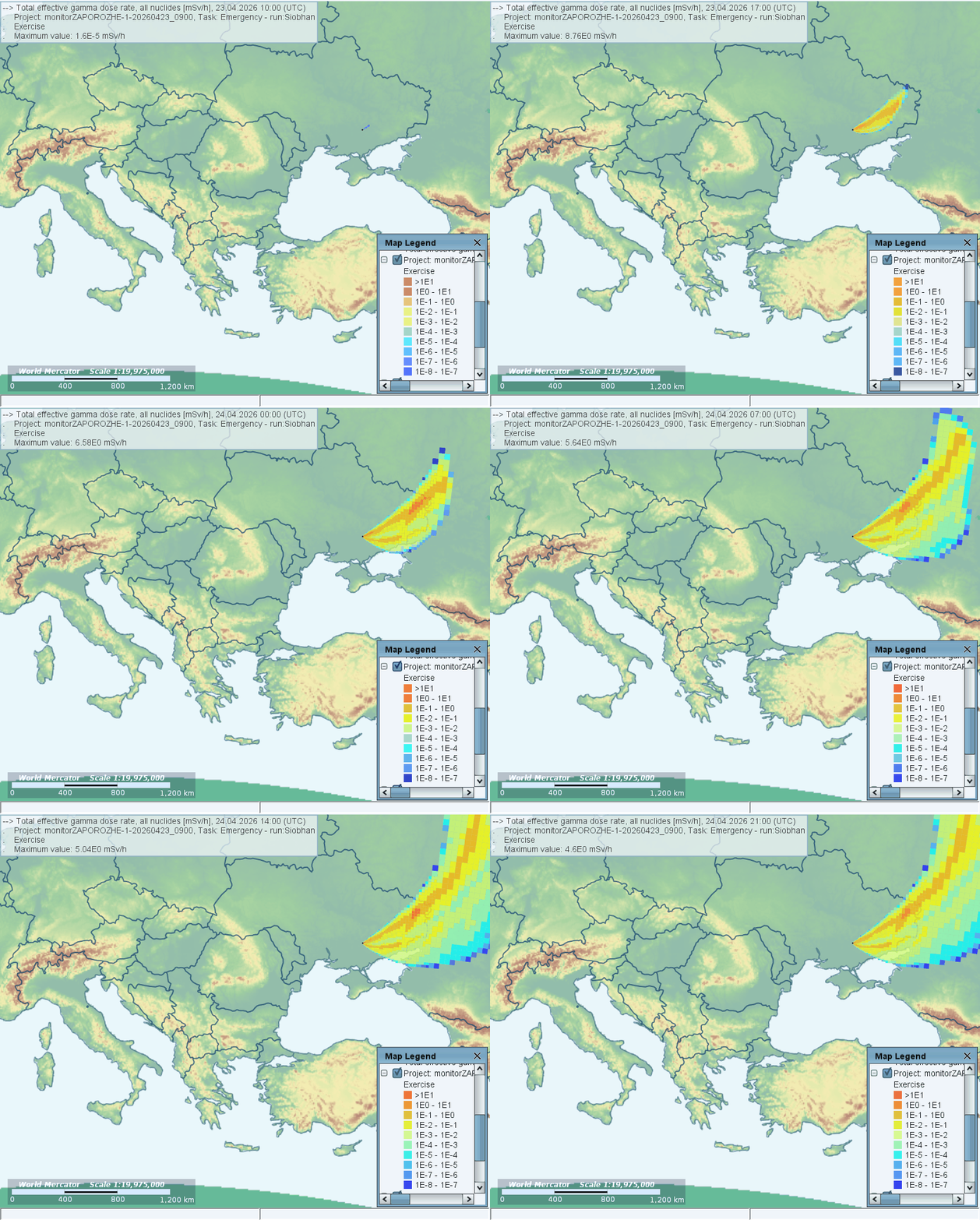 |
| Simulation of possible accident scenarios |
European research projects have brought together many users of the system and taken their interests into account in the further development of the system by KIT JRODOS research unit. This network of RODOS users and developers is continued within the RODOS Users Group. The group meets once a year to exchange experiences with the system and to discuss the possible further development of JRODOS. The next workshop will take place at CIPRIERN Emergency Operations Centre in Bucharest from 21 to 22 September 2026.
More detailed information on the status of the JRODOS system with its world-wide installation can be found here:
Contact:
Dr. rer. nat. Sadeeb Simon Ottenburger
KIT - Karlsruher Institute of Technology
Institute for Thermal Energy Technology and Safety (ITES)
Hermann-von-Helmholtz-Platz 1
D- 76344 Eggenstein-Leopoldshafen
Tel: +49 721 608 25507
Fax: +49 721 608 28452
Email: ottenburger∂kit.edu
Netzwerk/Plattformen:
Projekte: